• Open Letter
  • Foreword
  • Reviews
    • Musician Reviews
    • Press Reviews
  • News
  • Resources
    • Audio Download
    • Metric Modulation - BPM Calculator
  • About the Author
  • LEARN
  • Contact
  • Open Letter
  • Foreword
  • Reviews
    • Musician Reviews
    • Press Reviews
  • News
  • Resources
    • Audio Download
    • Metric Modulation - BPM Calculator
  • About the Author
  • LEARN
  • Contact
  Advanced Rhythmic Concepts for Guitar

LEARN
? + A 

EIGHTH NOTE PROBLEMS

3/3/2016

 
Picture

​Hello Jan,
 
Thanks for your reply.
 
I'm looking at getting your book to help my rhythm. But I'm not sure because it might be too advanced for me. I struggle with the basics of rhythm but am strangely drawn to fast syncopated music in the genre I play (flamenco).
 
I just have trouble knowing where I am in the rhythm when things get syncopated and fast, so when I play something syncopated and strongly accented I'm not sure that I’m hitting the syncopation accurately. Weirdly, I can feel when the syncopation is out but have no idea where I am in the rhythm, it's all over the place. I've been playing for many years but seem to be stuck at this point. I've talked to good players and some don't count at all and have awesome rhythm and then I've seen people on the net say you need to count at least in the beginning. This problem is not just when I’m playing guitar, if I try to clap straight rhythm over music that has some syncopation my clapping goes out of time.
 
Here's a specific example of the sort of thing that I have trouble playing tightly;
 
Imagine 2 subdivisions within a beat (1+, 2+). If I need to hit a chord on the off beats for say 3 or 4 beats at a fast tempo around 200bpm. If I play it slow I can count the subdivisions and play it fine but when I speed it up I'm lost. It's like I can count it but not feel it accurately, obviously when fast counting subdivisions is not easy and probably not a good thing.
 
One thing I’m guilty of is not using the metronome enough when I practice. Maybe I just need to use it, work with the metronome a lot more. Again I know musicians that have never worked with the metronome and have good rhythm - very annoying!
 
Hope all that makes sense, and you have some good suggestions to help me.
 
Cheers,
Andrew
(New South Wales, Australia)

​Dear Andrew,
 
You mentioned having problems with eighth note upbeats, so I’d recommend that you work on eighth note permutations.
 
You should practice with the metronome. Not only that, but you need to keep counting as well. If you can’t do it fast yet, that only means that you haven’t practiced it enough at a slower speed.  There's always going to be people that will learn some concepts faster than you can. You will be able to learn some other concepts faster than them. 

This does not mean that I am against practicing without the metronome. I’ve actually talked in favor of practicing without it on this post...

I am just saying that it  doesn't matter what other people need/don't need to use in order to learn a concept. The only thing that matters is what you need to learn it. If it doesn't come easy, then it is time to sit down and try to figure things out slowly with a metronome. 
 
Below this post, you will find two pages worth of eighth note and eighth note rest permutations  to use as a guide. You can find them at the end of this post as a PDF file. It is now up to you to write every possible eighth note & eighth note rest permutation inside of a 4/4 bar. Remember to include permutations using ties, dotted notes, accents, etc.
 
After this step is done, write out all of these permutations for every meter you are interested in playing. If you don’t feel like writing them out, you could also get a copy of:
Encyclopedia of Reading Rhythms: Text and Workbook for All Instruments
​Best of luck, don't give up...
​Jan
eighth_note_permutations.pdf
File Size: 44 kb
File Type: pdf
Download File


MEDLEY: SCORE, CHARTS & EXPLANATION

2/6/2016

 
Picture

In the last post you saw a video that displayed metric modulations, polyrhythms and polymeters. Some cool hats were also featured!!! 

For this post I will be explaining some of the most interesting rhythmic things that happened during the video. You can download the score as a PDF file at the end of this post. The video has also been embedded at the end for your convenience. 
​
Thanks go to Ray Rojo (drums) for taking the time to transcribe his playing  note for note!!!
​


Here are some of the things to look out for:
 
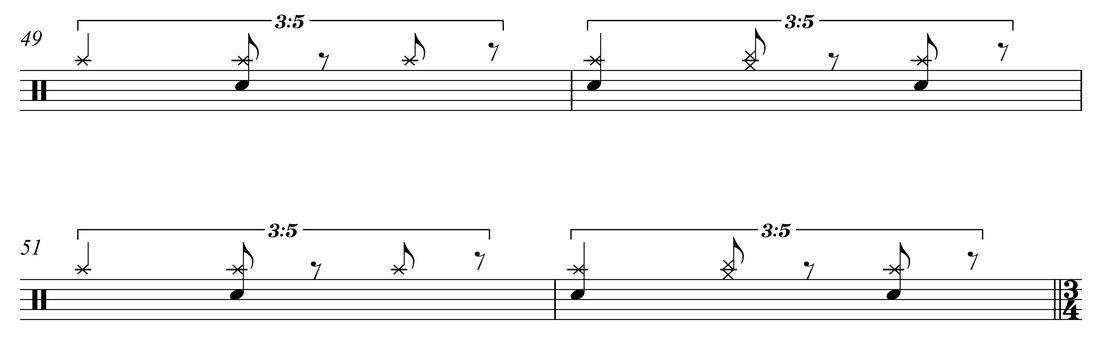
Bar 8: There is a 4:3 polyrhythm.

Bars 45-52:
​
Every four quarter notes inside of the 3:5’s form a phrase:
​
Picture

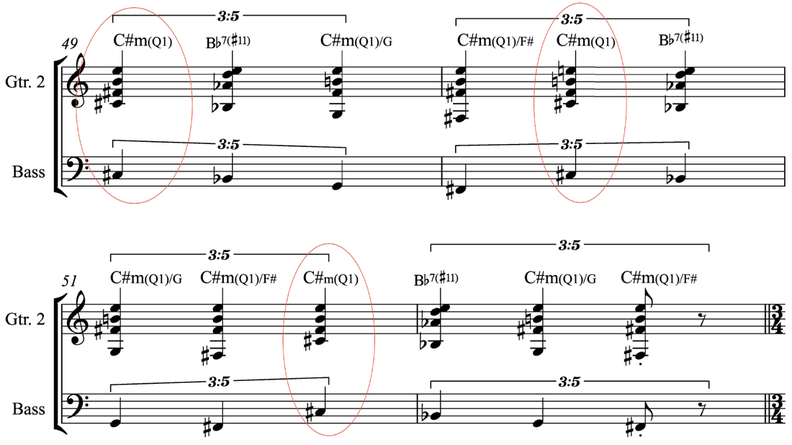
​You can also see the phrase when you look closely at the chords being played by the guitar, as well as the notes being played by the bass on bars 49-52. The beginning of each phrase has been circled in red:
​
Picture
​(In case you're wondering, the (Q1) is what I personally use to describe a quartal/stacked fourths voicing. The number 1 indicates that it is built from the 1st degree. Something else that you might have noticed is that rhythmic displacement has also been formed...)

​This four quarter note inside of a 3:5 phrase is a polymeter that, among others, could be seen in the following ways:


​Option #1​:


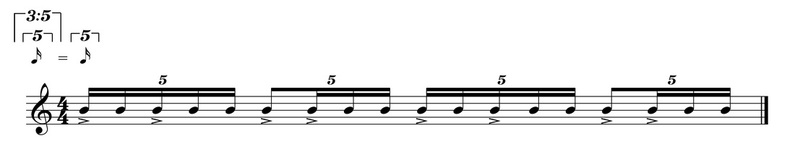
An explicit polymeter lasting 6 bars where the second meter is a 4/4 that looks like this:
​
Picture
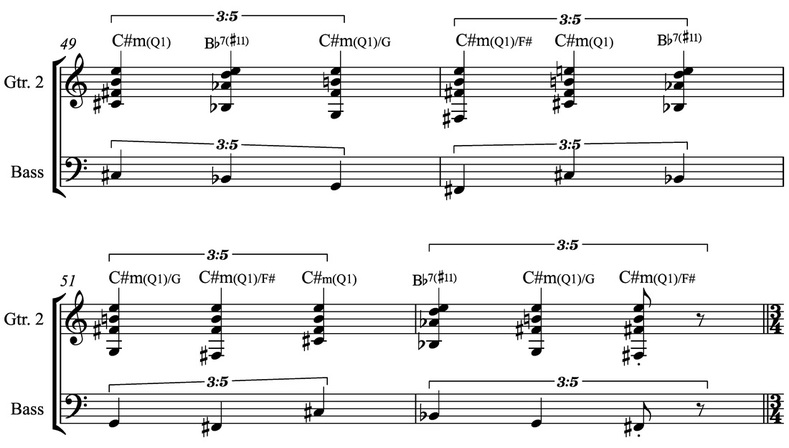
This option would sound the same, and not affect instrument charts. However, I see it as having a big impact on the score.  Writing it this way would not display the 3:5's which are at the core of the idea. Let's take another look at Guitar #2 and the Bass on bars 49-52...
​
Picture

​The drums also highlight the 3:5 during these bars. Let's look at the attacks that do so. For the most part, they happen on the cymbals...
​

Picture
​
​Another con of notating it as Option #1,  would be that if you wrote this out for every single instrument, a metric modulation would have taken place that completely eliminates the 5/4 time signature. 

​
I do not consider this as the best option for my example because the drums emphasize the 5/4, which in this particular case, I used as the "foundation meter"; referring to the meter over which the second meter is superimposed. (You can find more on why I chose the 5/4  as the "foundation meter" under Option #2.)

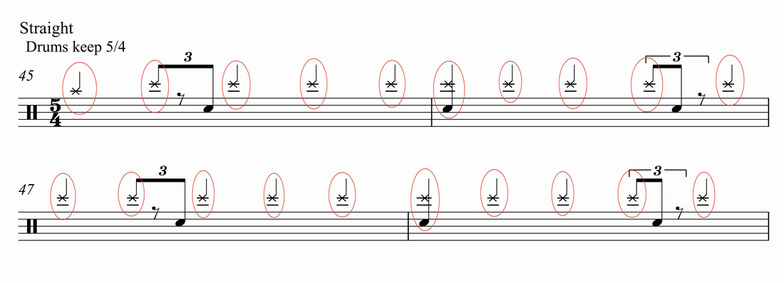
Take a second to look at the following attacks happening from bars 45-47. Ray's cymbal work is highlighting the 5/4 meter. Can you see it?
Picture
The 5/4 time signature would also be eliminated if we took Option 1 and:

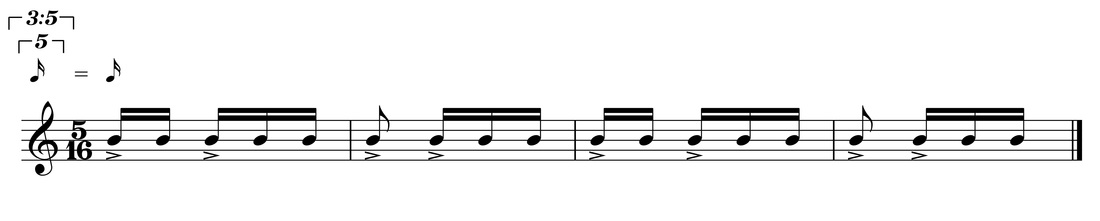
  • Equaled the 1st note to an eighth note and changed the meter to a 5/8.​ (Let's call this Option 1A.)
Picture

  • Equaled the 1st note to a sixteenth note and changed the meter to a 5/16.​ (Let's call this Option 1B.)
Picture
​Another problem with Options 1A and 1B, is the fact that we are looking for a 1 bar phrase and all of these turn our 4 quarter note phrase into a 4 bar phrase. (The 1 bar phrase problem is explained in more detail under Option #3.)

​
Couldn't you express the polymeter as an explicit one?
Yes.

Why didn't you?
​

The majority of musicians I've talked to prefer playing implicit polymetric notation over explicit polymetric notation. The top reason being that they can constantly track their position in relation to the "foundation meter". I've even seen some musicians go as far as ignoring the second meter altogether, performing it as a syncopated "foundation meter" instead.

I just noticed the accents on the phrase.  Don't they suggest a second meter with a numerator of five? Something like a 5/8 or a 5/16 meter?  
​

They could... 

In this case however, they are the divisions of each one of the four groupings found within one bar of the second meter I selected. As a matter of fact, my choice of accents had the intention of creating ambiguity.

​
Option #2:

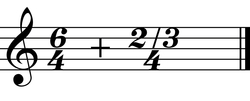
​An explicit polymeter where the second meter is comprised of a mixed meter 6/4 + 2/3 | 4 (lasting 6 bars). I say explicit because it would be difficult to identify as an implicit polymeter in comparison to some of the other choices presented, perhaps even a bit impractical. 
 
(Mixed meters can be found in the work of Elliot Carter, Edgar Varèse, and Pierre Boulez among others.) 
Picture
(The second meter of the mixed meters is a fractional meter. This type of notation can be seen in the work of  Pierre Boulez and Roman Haubenstock-Ramati among others.)

​Wait... Couldn't you write the mixed meter as the time signature and write the 5/4  as an implicit polymeter?

You could do that with every single option presented here...
​

Why didn't you do it like that? How do you choose which meter to write as the time signature? 
When I'm thinking of ideas, I tend to use my left foot to perform the "foundation meter" over which everything else is superimposed upon. In my particular case, that was the 5/4.

Choosing the mixed meter (6/4 + 2/3 |4 ) as a foundation meter could be an option, but my personal goal when notating something is to capture/describe/translate the idea as best as possible.  After all, notation is a means of creating a record for future reproduction. If you use it accurately, you will create a picture of your present thoughts and ideas for your future self to study/introspect/reminisce. 


​Option #3:


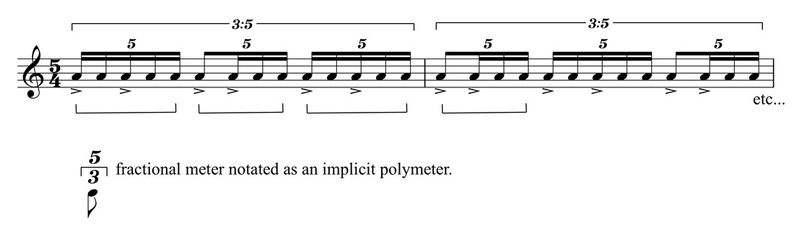
An implicit polymeter with a first meter of 5/4 (lasting 8 bars), and a superimposed fractional meter of
5 [3 eighth note (lasting 24 bars). Each bracket below the staff is identifying the duration of one bar of the fractional meter. 

​
(Notation of fractional meters such as the one below the staff can be found in the work of Charles Wuorinen.)
Picture
Something  I don't like about this option is that it does not cover the entire phrase. My "one"/downbeat is steadily showing up after the 4th group of notes. If you remember, this is why we considered Option 1 in the first place. 

We are getting closer though, we just need a fractional meter that covers the entire phrase...

​
​​Option #4:


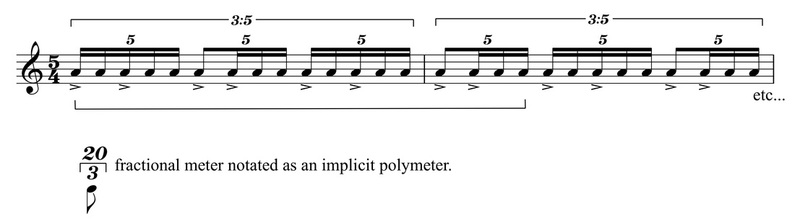
An implicit polymeter with a first meter of 5/4 (lasting 8 bars), and a superimposed fractional meter of
​20 [3 eighth note. (lasting 6 bars). The bracket below the staff is identifying the duration of one bar of the
​fractional meter. 


(Notation of fractional meters such as the one below the image can be found in the work of Charles Wuorinen.)
Picture
​This last choice is how I view it personally, and what I was thinking at the time. It is easier to notate as an implicit polymeter, and the entire phrase is captured under this second meter. 
​

How do the drums come into play?
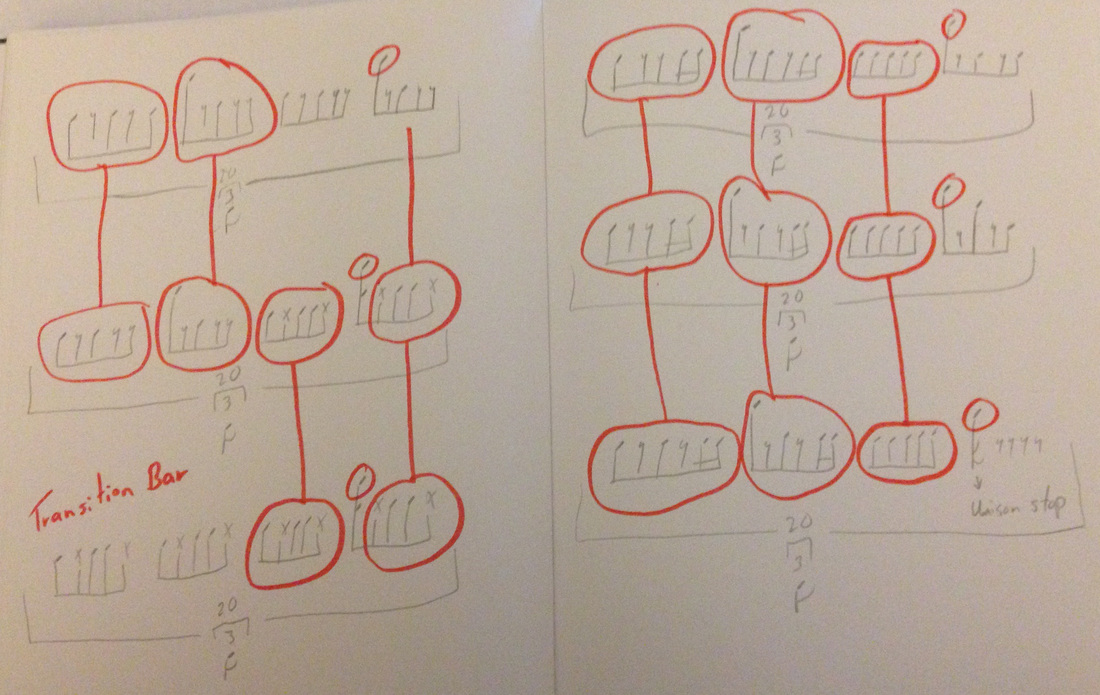
Below is a picture of all the drum attacks consolidated into the 20 [3 eighth note fractional meter. I have kept the attacks in groupings of 5 notes as shown on the quintuplets under the 3:5 polyrhythm to make it easier to visualize. No note brackets are shown for the same reason.

Do you see any patterns being formed? The left page features the bars 45-48, (where the drums highlight the 5/4),  and the right page features bars 49-52 (where the drums highlight the the 3:5 polyrhythm). 

Everything circled in red is identical...
Picture
Here are some things to look for in the picture above:
​
  • There is a one bar pattern happening in each of the 6 bars.
  • Each bar on "section one", (where the cymbals highlight the 5/4 on bars 45-48 of the score), is almost identical.
  • There is an exception on the third bar, as it acts as a transitional bar into "section two" (where the cymbals highlight the 3:5 on bars 49-52). 
  • Each bar on "section two" is almost identical. The only exception is a stop after the last attack , which is due to the end of a section. 

​Before we move on, couldn't you just have notated everything as a "normal" implicit polymeter for the
20 [3 eighth note fractional meter? Why did you decide to notate the implicit polymeter as subdivisions of the 3:5 quarter notes?


You could... 


I personally chose not to because it would not display the 3:5. Again, 3:5  is the figure from where this entire idea is derived from. Let's not forget that our phrase lasts 4 quarter notes inside of a 3:5.

Even though those 4 quarter notes last the same amount of time as a bar of the 20 [3 eighth note fractional meter, I see both notations as being equally important.

​
The fractional meter:
  • Accounts for the length of duration of the entire phrase. 

​
The 3:5 subdivisions:
  • Work as an indicator of what the ensemble is doing as a whole.  
  • In my opinion, make it easier to see the 4 quarter note phrase/fractional meter.
  • Point towards the fact that this figure is at the center of how this idea was conceived. 

​
Personally, I think that the most practical way for me two show both functions was to display the fractional meter as subdivisions of the polyrhythm. 

​
​Other things that might interest you:


​There are rhythmic displacements happening in the following bars:

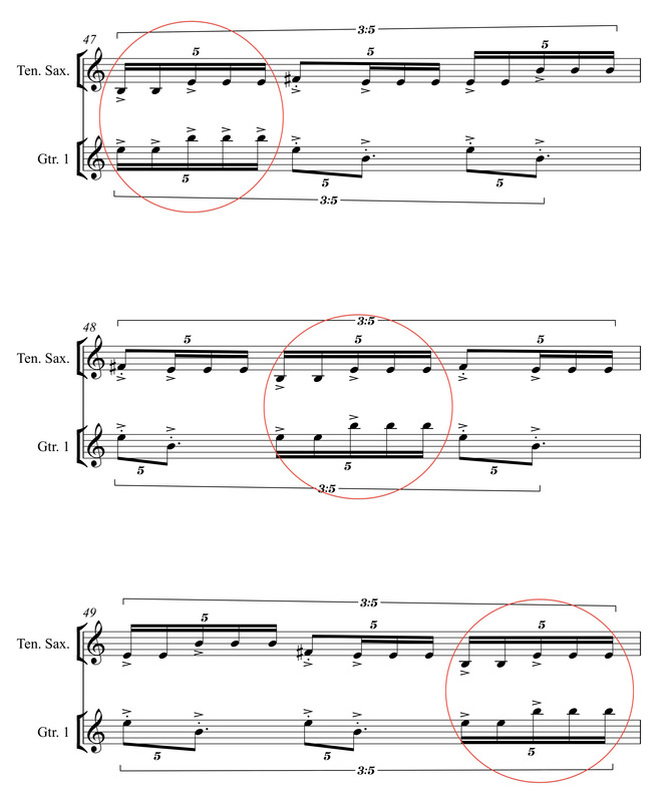
Bars 47-49: In regards to the 5/4, Tenor Sax 1 & Guitar 1 perform a rhythmic displacement that begins on the 1st quarter note of 3:5 then moves to the 2nd quarter note of 3:5 and finally moves to the 3rd quarter note of 3:5.

​Here's how it looks on the score. I've eliminated all other instruments so that it is easier to see:
​
Picture
​
​This same displacement is performed by the bass during  bars 46-48.

​During this section, the soprano sax only plays on bars 49, 51 and 52. When looked at continuously you can also see some rhythmic displacement happening. 

​
Well, I hope that this post has given you some choices to consider when writing your own music.

​At the very least you should have enjoyed the hats...

Best,
Jan 
​
medley_score.pdf
File Size: 189 kb
File Type: pdf
Download File


​

A YEAR TO THE DAY...

12/3/2015

 
Picture

Exactly one year ago, the "LEARN" section of this site started. As a thank you, I am attaching a tune that features 4:3 polyrhythms at the end of this post.

I look forward to answering more of your questions, as well as reading  your e-mails  in the future.

Thank you so much for reaching out.

​Best, 
​Jan 
strange_as_it_may_seem.pdf
File Size: 60 kb
File Type: pdf
Download File


Q&A: THE PRACTICE CONUNDRUM

11/23/2015

 
Picture

Hi Jan,

I​t's encouraging to see how involved you are with your subscribers.
 
I recently graduated from music school and have started working in a non-music school job. My biggest struggle is knowing what to practice, given the limited amount of time. I try to keep it to the most important things for me: rhythm, harmony, and melody. It's within those themes that I start to stumble, I mostly practice my time with a metronome and recently I have been wanting to introduce new rhythmic concepts into my playing, hence why I purchased your book and signed up for your website. 
 
I try to practice at least two hours a day but I find even when I reach that the practices don't feel very successful.
 
I've also tried combining different approaches to learning multiple things at once, such as practicing a new voicing and its inversions while playing a specific rhythm over a tune or vamp. But I think that's too ambitious. 
 
Hope this isn't too long, any guidance, advice or positive practice experiences are greatly appreciated.
 
Thank you,
Andres
(Brighton, Massachusetts)


Hello Andres,
 
Deciding on what to practice can certainly feel daunting at times. There are a million concepts and only one of you.
 
I think that you where onto something when you talked about consolidating concepts. However, I would suggest that you first learn them individually.
 
In addition, I would suggest that all of your practices focus on applying the concepts that you are working on. A lot of students practice with two folders: the “practice” folder and the “playing” folder; never applying some of the concepts they practice. I’ve even seen students religiously practice concepts without having any idea as to how they are applied.
 
Below is an example of a practice routine that incorporates all of the elements you mentioned. I have attached it as a PDF file in case you’d like to use it as a starting point.
 
 
Melody:
 
  1. Read the “head”/melody until you learn it and can play it comfortably.
 

Harmony:
 
  1. Practice your chords until you can “comp” the tune up to tempo.
  2. Practice any inversions you’d like to add.
  3. As well as any other devices such as quartal harmony/stacked fourths etc.…
 

Improvisation:
 
  1. Practicing improvising scales/modes over the changes.
  2. Practice improvising implicit polymeters over the tune.
  3. (You could use a polymetric improvisation template to start.)
  4. Practice improvising polyrhythms over the tune.
 
You might not be able to get through all of this in one day, but the important thing is to go through the full list. As the days go on, everything will be easier to do, and you will be able to practice more concepts.
 
Eventually, you will just run through the whole tune, practicing a different concept every time you run through the form. Once you feel that you can do this comfortably, start mixing the concepts.

Are you done yet? Grab a new tune, wash, rinse and repeat!

Best,
Jan


practice_routine_example.pdf
File Size: 39 kb
File Type: pdf
Download File


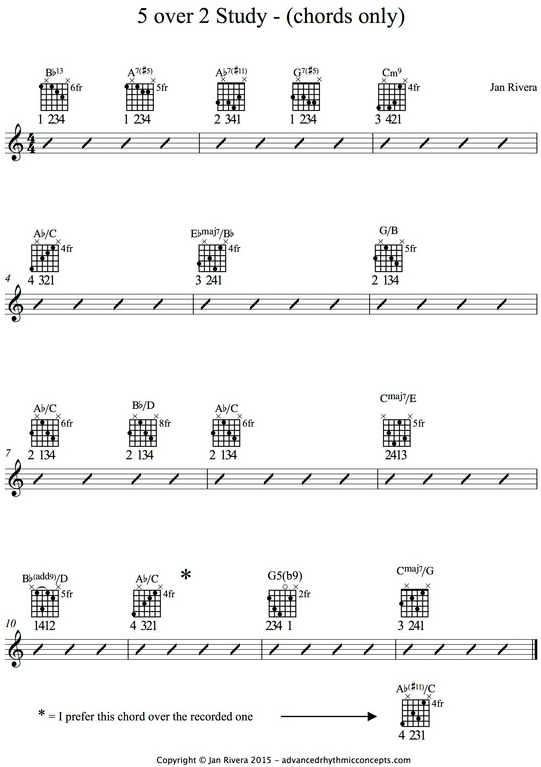
CHORDS FOR THE 5 OVER 2 STUDY

6/30/2015

 
Picture


Hi Jan,

This is a cool way to further my learning process. Actually, the first time I heard about using the metronome more and breaking it down how you have the first two chapters, was when I watched a seminar/class on YouTube from Kenny Werner. I'm so glad to see this laid out in a book. I'm plugging away through the 2nd chapter for about a week now. I find it's very rewarding once I learn how to play the 5 over 2, and 4 over 3. I'm still working on the 3 over 5, and 3 over 7. They can be tricky. I love using the stonekick metronome beats app with these exercises.

Also, I kind of wish you put the chord names over top of the 5 over 2 study. Very nice piece by the way. I feel I've barely scratched the surface in this book. And I've already learned so much. 

Regards,
Chris
(Cleveland, Ohio)

Hi Chris,

Thanks for the kind words. It makes me so happy whenever I hear that someone is benefiting from the book. I cannot help but feel humbled when I learn that a person is taking the time to thoroughly study each chapter. 


Kenny Werner has some great stuff! I really like his “Effortless Mastery” series, and have both his book and DVD. It’s something to check out if any of you haven’t yet.


About why I didn’t print the chords:

At the time, I thought that if I went into harmony it might distract from the rhythmic aspect of the book. I even wrote about it during the introduction. I’m going to go ahead and post them for you as both a picture, and a downloadable PDF placed below the picture. Note that on bar #11 there is an asterisk. It indicates that the chord displayed over the bar is the recorded chord. However, I prefer the one added below the sheet.

As part of your routine, try to incorporate some of the book concepts into your playing/composing. That way, you will get the most out of them.

Best,
Jan

Picture
5_over_2_study_chords_only.pdf
File Size: 75 kb
File Type: pdf
Download File

    "LEARN"

    Answers to the questions of "Meters and News" subscribers, as well as some articles, are posted in this section of the website.

    Archives

    May 2021
    April 2019
    August 2016
    April 2016
    March 2016
    February 2016
    December 2015
    November 2015
    October 2015
    August 2015
    July 2015
    June 2015
    May 2015
    March 2015
    February 2015
    January 2015
    December 2014

    Categories

    All
    Downloadables
    Fractional Meters
    Metronomes
    Mixed Meters
    Polyrhythms VS. Polymeters
    Practicing Tuplets

    RSS Feed

    Picture
    Picture


      Subscribe to Jan's Newsletter for Giveaways, News, and Early Access to Videos

    Subscribe to Newsletter
Advanced Rhythmic Concepts for Guitar © Jan Rivera 2021